



Renting or owning your website: what really changes
When you build a website, you think about design and timing first. The ownership question often comes too late: on the day you want to change tools, providers or direction. Yet it is the one that decides how free you are in the years that follow. This article compares, without figures and without judgement, what you really own when your website is rented on a platform, and when it lives on infrastructure in your name.
Renting, owning: what do we mean?
Renting a website means using a platform that supplies everything in one place: the editor, the hosting, the theme, often the payments. Wix, Squarespace and Shopify work this way. You pay a subscription, and the platform runs your site on its own servers.
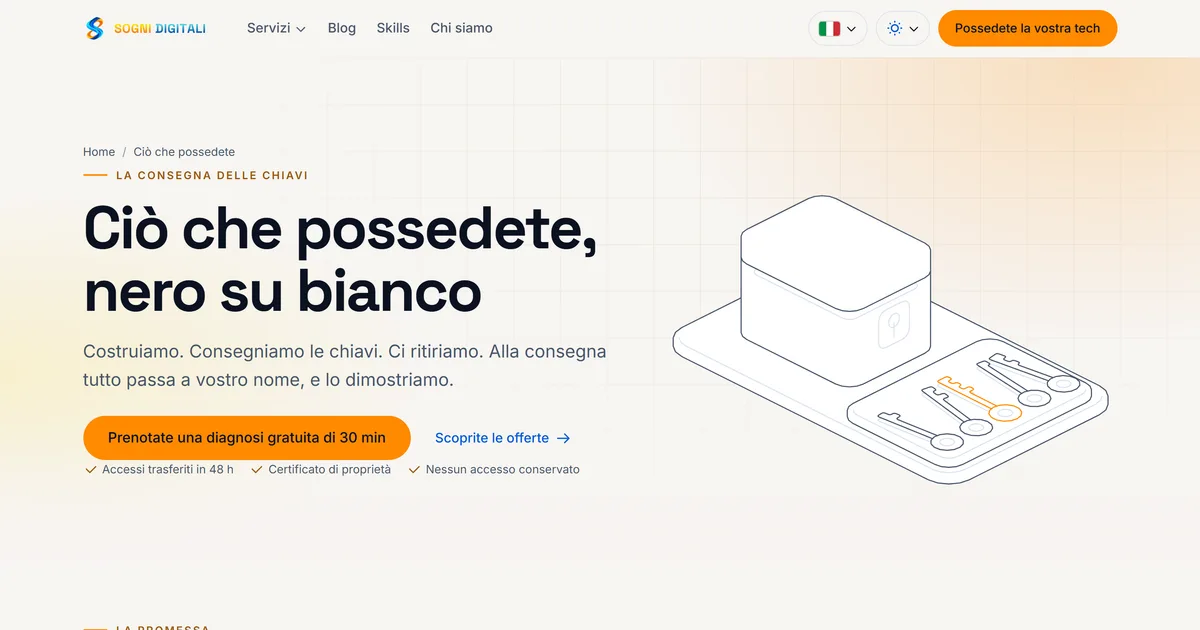
Owning a website means having every part in your name: the domain, the server, the code, the database and the supplier accounts. Someone builds the site for you, then hands over the keys. You pay your suppliers directly, the way you pay for electricity.
Both models are legitimate. The difference shows on four points.
1. The domain
The domain is your website's address, and often your email address too. It is the most important item, and the easiest to protect.
- On a platform: the domain can be bought there or elsewhere. In principle it can be transferred, but you need to check whose name it is registered in.
- On your own infrastructure: the domain is registered in your name, on a registrar account you control.
Picture a bakery whose domain was registered by a former provider, on that provider's own account. The day the relationship ends, the bakery has to get the domain back before it can change anything, email included. This happens often, and it takes one check to avoid: who is the registered owner of your domain today?
2. The code and the design
- On a platform: your site is built with the platform's technology. Your text and images belong to you, but the site itself, its structure and its theme, only runs there. You cannot take it away and host it somewhere else.
- On your own infrastructure: the source code sits in a repository you own, with the documentation needed to pick it up. Another developer, or an AI, can keep improving it.
This matters most on the day you need a feature the platform does not offer: a specific quote calculator, a link to your management software, a page reserved for your resellers. On a platform, you depend on what it provides or on the add-ons available. On your own infrastructure, the question simply becomes: who writes it, and how long will it take?
3. The data
Your data means your contacts, your customers, your orders, the messages sent through your forms and your visitor statistics.
- On a platform: it is stored on the platform's servers. You can export part of it, often as a CSV file, depending on what each module allows.
- On your own infrastructure: it sits in a database on your server, in Europe if you choose. You export it whenever you like, in full.
It is also a matter of rules. Knowing exactly where your data lives helps you meet GDPR requirements and answer your own customers' questions, especially if you work with companies or public bodies that ask in writing.
4. The exit
This is the real test: what happens on the day you leave?
- On a platform: you take back your content and your domain, then the site is rebuilt elsewhere. It can be done, but it is a project in its own right: URLs to redirect to keep your search ranking, pages to rebuild, forms to reconnect.
- On your own infrastructure: there is nothing to migrate. You change provider and keep the server, the code and the accounts. The new provider simply gets an access, which you can remove later.
One simple question to decide
Ask yourself: "If my platform or my provider disappeared tomorrow, what would I be left with?" The answer tells you almost everything about what you own.
When renting makes sense
Owning is not always the right choice. Renting a platform makes sense when:
- you are testing an idea and want to be online within days, on your own;
- your site is a business card that will rarely change;
- you have neither the time nor the wish to look after hosting and renewals;
- owning the code and the data does not matter for your business;
- you accept rebuilding everything on the day you leave.
In these cases, a platform does the job very well. If that is your situation, we will tell you during the free call.
When owning starts to matter
Ownership gains value when:
- your site brings in enquiries or sales every week;
- you want to connect it to other tools: CRM, invoicing, stock management;
- your customer data is a business asset;
- you plan to change provider one day, or to bring the work in-house;
- you want to know, before you sign, what you will pay the following year, and to whom.
What "owning" means at SOGNI DIGITALI
At SOGNI DIGITALI, every project is built directly on infrastructure in your name. At the key handover, you receive:
- the domain, the server and the supplier accounts, in your name;
- the source code and the database, with the documentation;
- a SKILL.md file, readable by any AI, that explains how your site works;
- an ownership certificate listing every item handed over.
Then we remove our own access. The details are on the What you own page, and the comparison with platforms on the Compare page.
Before you decide: five checks
- Who is the registered owner of my domain?
- Can I export my contacts and orders, and in what format?
- Can my site run anywhere other than with my current provider?
- Who holds the admin passwords?
- What would I have to rebuild if I changed provider?
If you do not know all the answers, that is a good starting point for a free 30-minute call.

Likes and comments
No account needed: one like per browser, which you can remove. Comments are published after review.
Comments are shared between the English, French and Italian versions of the article: each one appears in the language it was written in.
Loading likes and comments…
Comments
Leave a comment on this article